

Training is where process, people, and technology meet… and this intersection is where the most quality breakdowns occur.
To get a better understanding of when and why this happens, we surveyed 100 quality management professionals in life sciences organizations, including CROs, CMOs, biopharma, laboratories, packaging/logistics, and manufacturing.
Across all sectors and system types, training remains one of the most persistent challenges in quality management.
In fact, more than 70% of survey respondents report “moderate” to “considerable” difficulty managing training. Specifically, the top three struggles quality management teams face with training are:
-
On-time training assignment completion
-
Competency and content retention
-
Time and budget constraints for training initiatives
What’s interesting is that this is true regardless of system sophistication. Teams relying on manual quality management and those using digital systems struggle to maintain engagement and measure competency over time.
Organizations that report stronger training outcomes tend to combine several approaches: automated tracking, regular competency evaluations, structured feedback collection, and role-based training matrices that are updated on a predictable cadence (often quarterly rather than “only when needed”).
So what does this actually look like in practice?
How life sciences teams measure training effectiveness (and where it falls short)
It seems Quality teams are trying anything and everything to keep their teams compliant on training.
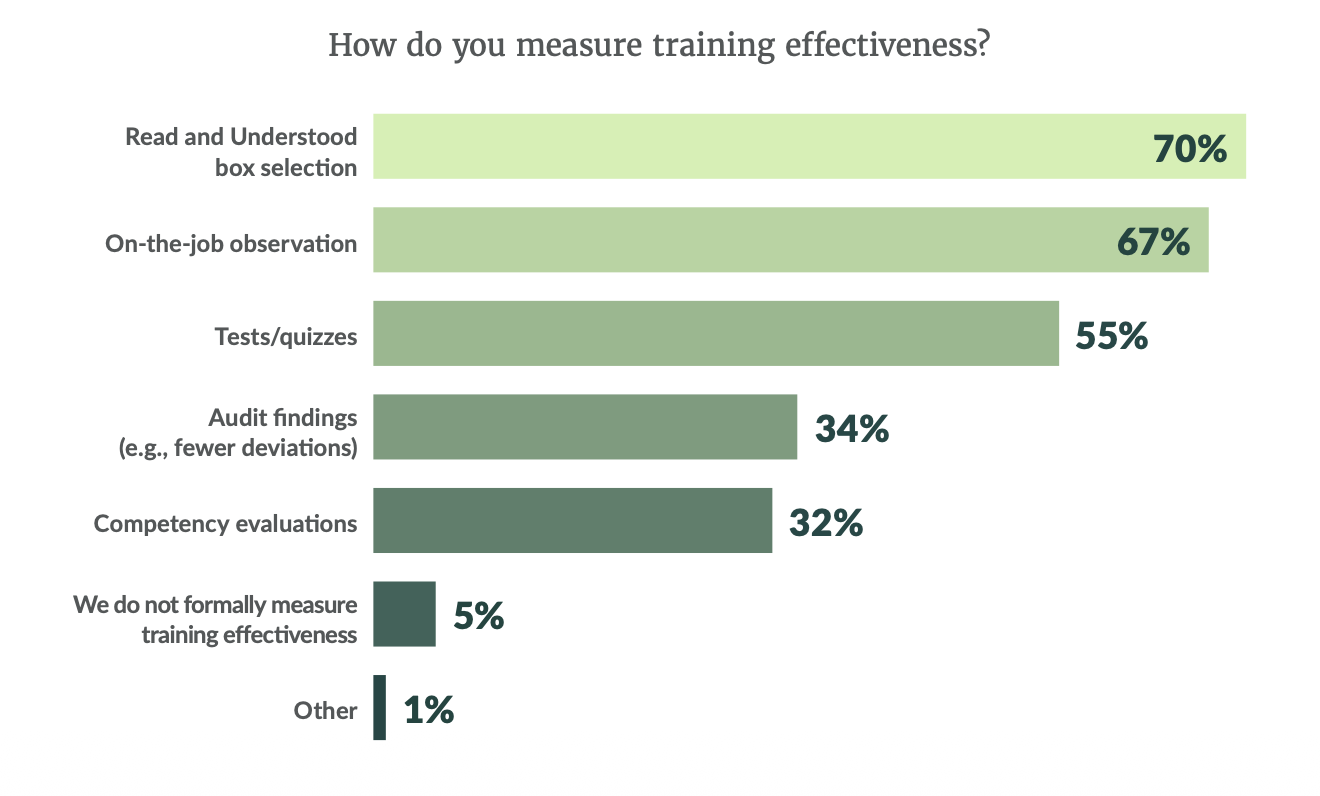
While 70% rely on “read and understood” acknowledgments, many supplement it with other methods like:
- Tests or quizzes (55%)
- On-the-job observation (67%)
- Competency evaluations (32%)
Surprisingly, 5% report not formally measuring training effectiveness at all…
As far as training matrix maintenance, the most common approach is “only when needed” (44%). Quarterly updates (17%) are less common but tend to align with organizations reporting more effective training programs.
Feedback collection on training looks to be less of a priority and is less consistent across Quality teams. In fact, 38% of respondents stated they don’t collect feedback on training content at all. Others rely on one-on-one discussions (51%) and/or post-training surveys (27%).
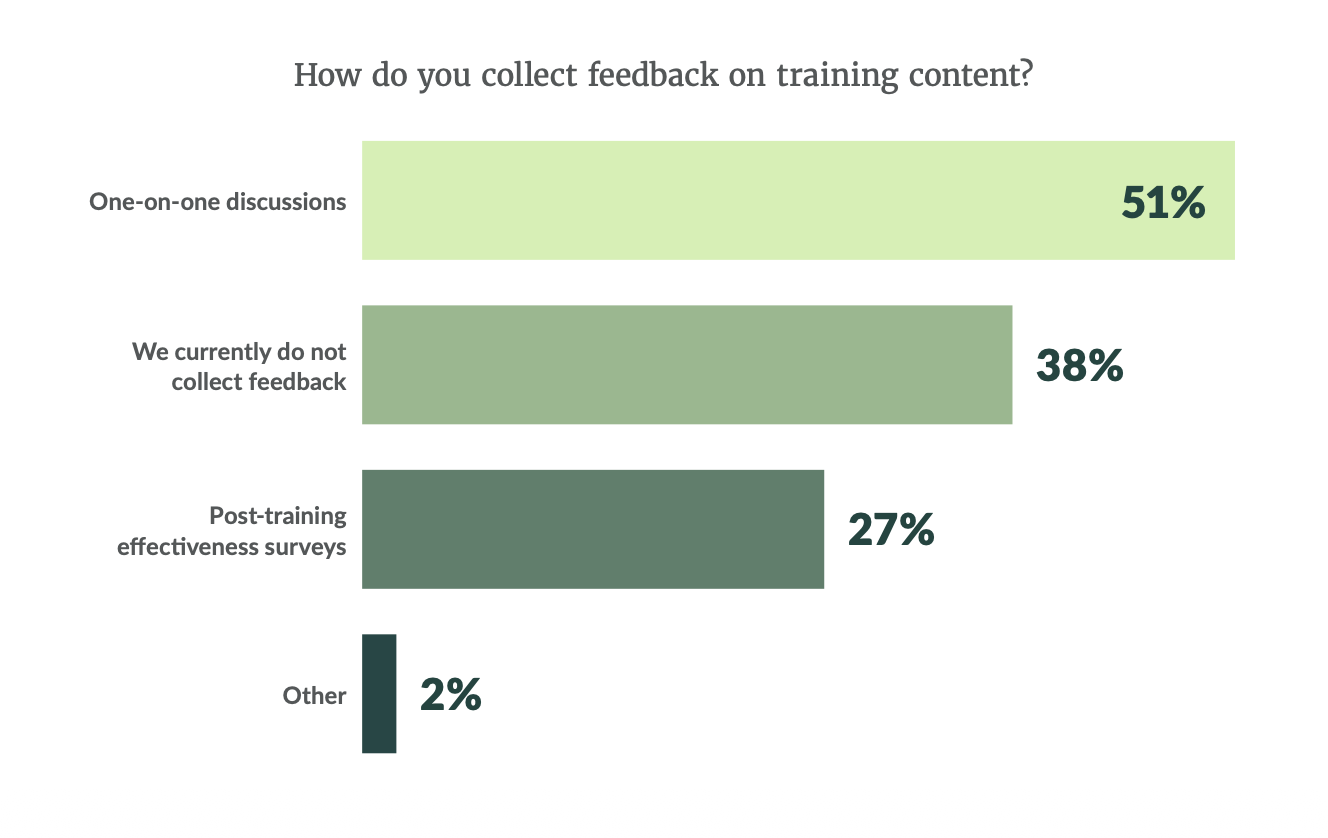
Without feedback or matrix maintenance, it’s harder to improve training programs over time… but without budget or resources, these upkeep tasks are nearly impossible to prioritize.
Why eQMS choice matters for training management and compliance
Though eQMS users are twice as likely to report their training management to be highly effective than manual users, training still remains a universal bottleneck for life sciences organizations of all kinds.
Getting a digital system is a critical first step, but because training touches every part of the organization, even small inefficiencies spiral out of control quickly. If your eQMS doesn’t fit your organization, you won’t see the time and compliance gains you’d expect.
The best eQMS for training management
So, how do you make sure an eQMS will actually help eliminate training bottlenecks? A few features can make the difference:
1. It’s built for the everyday user (not just Quality managers)
If your users struggle to find their training assignments, you can pretty much guarantee they won’t complete them. The best eQMS platforms make training completion obvious and frictionless. That means:
- Clear dashboards showing exactly what’s due
- Simple navigation to access and complete training
- Minimal clicks between assignment and completion
Easy to complete = easy to complete on time.
2. It automates the tedious tasks
After hours spent tracking overdue assignments, sending reminders, and following up with managers, your Quality team could probably list “professional people chaser” on their resumes.
Instead, pick an eQMS with:
- Automatic training reminders and notifications
- Escalations for overdue training
- Visibility for both users and managers
And most importantly, make sure it has the ability to automate training assignments triggered by major document revisions or periodic retraining schedules. Not only does this cut down on a tedious manual task, it makes sure your team is never operating on outdated information.
3. It creates training management reports that influence decisions
Data drives improvement, so pick an eQMS that makes it easy to collect and report on your training data. It should help you spot patterns early and intervene quickly by answering questions like:
- Where are we at risk?
- Who is consistently overdue?
- Which trainings are most often missed or delayed?
- How does compliance vary across teams or roles?
Another way to save time (and improve compliance): Built-In GxP training content
An eQMS can save teams a lot of time spent on training management, but what about training creation?
For that, you’ll want to look for eQMS platforms with the right partnerships.
For example, ZenQMS has partnered with Biopharma Institute – experts in regulatory, validation, compliance, and GxP training – to offer over 75 high-quality courses directly in the ZenQMS platform.
Being able to access the GxP content within the same platform is huge. It means you can add, assign, and track training content directly within your eQMS, no need to validate or manage a separate LMS.
It also eliminates hours spent monitoring and revising training content. Courses are always kept up-to-date by Biopharma Institute’s experts with the latest regulatory and compliance requirements.
The courses cover everything from clinical trial management, drug safety, manufacturing practices, pharma regulatory affairs, and much more. You can see the full list of course offerings here.
But no matter which eQMS platform you choose, the name of the training management game is to reduce friction at every stage of the process. If you’re curious to see how ZenQMS tackles this from content creation and assignment to reminders and reporting, let’s talk.