

Quality management at contract manufacturing organizations (CMOs) and CDMOs comes with its own unique set of challenges.
Each client brings different compliance expectations. Every program introduces new documentation, training requirements, and audit scrutiny... and it all has to be managed accurately without slowing down production.
Data from the 2026 Quality Management Industry Report shows just how wide that operational range can be, with CMOs reporting anywhere from 52 to over 2,000 active documents, plus a similar range in training requirements and audit demands tied to multi-client work.
Don’t forget, the report also found most quality teams across all sectors operate with only 2-5 members, with 49% given a quality tool budget of less than $15k. For quality teams at manufacturing organizations, that number jumps to 87%.
Below, the data shares a clear picture of the sheer volume and variety CMOs and CDMOs face.
Document volume is the first sign of increased pressure… but retrieval times are the real indicator of quality maturity
For CMOs, every new client introduces an entirely new layer of SOPs, batch records, training requirements, and audit expectations.
But while an ever-growing document count does add pressure to the Quality team, document volume doesn’t guarantee risk. It's an organization’s ability to actually find those documents and keep them in a state of control that gives you a clear idea of their quality maturity
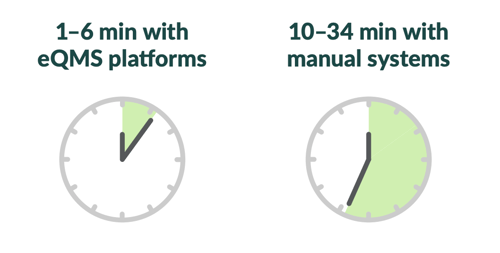
According to the report, document retrieval times for CMOs/manufacturers range from 1 minute to 34 minutes.
That’s a big gap. And it’s also where CMOs that prioritize their Quality teams get a leg up over competitors.
Manufacturing organizations that invested in an eQMS retrieve documents at least 10x faster (1 - 6 minutes) than those relying on manual quality management (10 - 34 minutes).
Predictably, version control also appeared as a major challenge for manual users, with participants often rating it a considerable or severe issue, while digital adopters reported little to no difficulty.
Imagine taking 10 minutes to find one document during a potential client audit (let alone 34 minutes!). It could be the difference between a contract win and a reputation loss.
Training management is where CMOs feel the strain
Document control is the foundation of quality management. When it starts to shake, the other facets follow suit.
CMOs/manufacturers feel the strain with training management in particular and the report shows just how inconsistent training demands can be across organizations:
-
Training coverage ranges from 10% to 100% of documents annually
-
Role-based training loads range from 5 to 52 documents per position
Each client brings its own expectations around who needs to be trained, on what, and how often.
For Quality teams, this creates a moving target, and it shows in the responses from our survey participants. Some teams report reviewing and updating training matrices monthly, while others revisit them “only as needed.” Both approaches come with tradeoffs. Frequent updates increase administrative burden, while infrequent updates increase the risk of outdated or incomplete training.
Without a centralized system to manage all of this, even small gaps can quickly turn into larger compliance risks.
Why Manual Systems Break First in CMO Environments
Spreadsheets and shared drives might work in simpler environments. But CMO operations aren’t simple.
When you combine:
-
Hundreds (or thousands) of controlled documents
-
Constant training updates tied to those documents
-
Multiple clients with different expectations
Manual systems start to show their limits quickly, and the data shows it. Based on their quality system, the report states CMOs see operational ranges like:
-
Audit preparation time ranges from 5 to 48 hours
-
Issue resolution timelines range from 1 to 12 weeks
Yes, manual quality management is a burden on the Quality teams responsible for keeping CMOs compliant, but it’s also a significant risk factor for slowed production schedules, unmet client timelines, and ultimately, lost customer trust.
As CMOs grow, adding more people isn’t always enough to keep up with increasing demands.
At some point, the systems supporting quality management need to evolve as well. And the ones who set the foundation early will make sure their Quality teams are better equipped to support both compliance and growth.
How GMP organizations can connect quality management with equipment & asset control
For organizations operating in GMP environments, quality management extends beyond documents, training, and audits.
Equipment management, calibration, and maintenance play just as critical a role in maintaining compliance and keeping production on track. And just like document control or training, these processes become more complex as operations scale and client demands increase.
Managing these processes in separate systems can create gaps in visibility and slow down response times when it matters most.
Through ZenQMS’s partnership with Blue Mountain, we’re helping GMP organizations close those gaps.
Here’s how:
-
Quality Event Management: Automatically link asset failures and maintenance events in Blue Mountain RAM to NCRs in ZenQMS, giving quality teams full asset context for investigations and CAPAs.
-
Change Control Automation: Trigger change control workflows in ZenQMS based on asset changes, maintenance outcomes, or calibration status to support controlled, compliant updates to GMP assets.
-
Centralized Document Access: Enable maintenance and calibration teams in Blue Mountain RAM to reference the latest approved SOPs and controlled documents managed in ZenQMS.
-
Training Verification: Validate technician training and qualification status in real time before maintenance or calibration work is performed, helping reduce compliance risk and prevent execution delays.
For growing GMP organizations, this kind of alignment helps reduce risk, streamline audits, and support production without unnecessary delays.
Learn more about the ZenQMS + Blue Mountain partnership.
Download the Full Industry Report
Want more insights like this on the quality management industry?
In our latest report, Quality Management in Life Sciences: Benchmarks, Burdens, and Breakthroughs, we break down:
-
The average size and resource allocation of Quality teams
-
Typical workload volumes across documents, training, audits, and CAPAs
-
Quantifiable efficiency and compliance differences between manual and digital QMS environments
-
Sector-by-sector quality benchmark data
-
Insights on AI readiness and use in Quality Management
And if you're evaluating how to build a strong digital foundation, our team at ZenQMS is always here to help you think through what that evolution should look like for your organization.