

Technically, quality teams can (and do) manage quality manually without the help of any digital tools like an eQMS, DMS, LMS, etc.
But should they?
According to the compliance and efficiency data in the 2026 Quality Management Industry Report, absolutely not.
When comparing the quality activities of teams using manual vs digital quality management tools, the difference shows up in tangible ways: how long it takes to find a document, how much time teams spend preparing for audits, and the effectiveness of training management. The list goes on.

The efficiency gap between manual and digital quality management
Before we look at effectiveness, let’s focus on one of the scarcest resources Quality teams have: time.
Across the board, teams using manual or hybrid setups consistently report longer time spent across core quality activities.
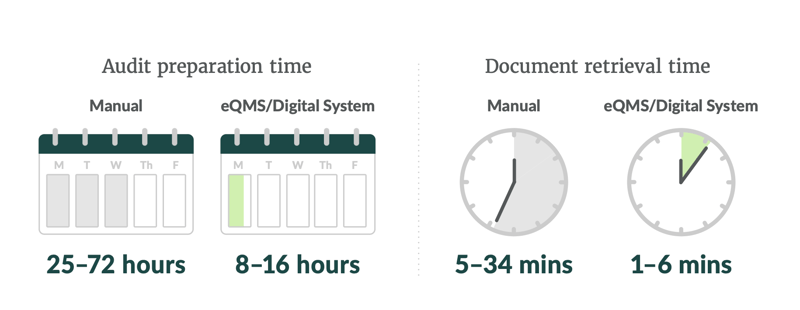
Take document retrieval times, for example. Teams using manual systems report retrieval times ranging from 5 to 34 minutes, while those using eQMS typically locate documents in 1 to 6 minutes. The same pattern appears over and over again in audit preparation, training management, and reporting.
-
Audit Preparation: Manual-system users spend 25 to 72 hours preparing for an audit, compared to 8 to 16 hours for teams working in digital environments.
-
Training Management: Weekly training management also takes nearly twice as long for manual teams (4.7 hours per week) compared to digital teams (2.2 hours per week).
-
Quality Data Reporting: Quality teams using manual systems spend an average of 3.9 hours compiling each KPI report, while digital users report closer to 2.1 hours.
One contributing factor is tool sprawl.
Teams using eQMS platforms typically work within one to two integrated systems, while manual teams rely on an average of three to five different tools, often a combination of spreadsheets, shared drives, cloud storage, and physical files.
Each additional tool adds coordination overhead, cost, confusion, and of course, time.
The compliance difference between manual and digital quality management
“Time saved” isn’t the only indicator of a successful quality system. After all, compliance is the ultimate goal.
And the data shows that’s also significantly impacted by whether a team is utilizing manual or digital tools.
Version control stands out as one of the clearest contrasts. Among manual-system users, 67% report version control as a severe challenge and 33% as a moderate challenge. Not a single manual respondent reported version control as “not a challenge.”
In contrast, only 8% of eQMS users describe version control as a severe challenge, while 67% report it as not a challenge at all.
Plus:
-
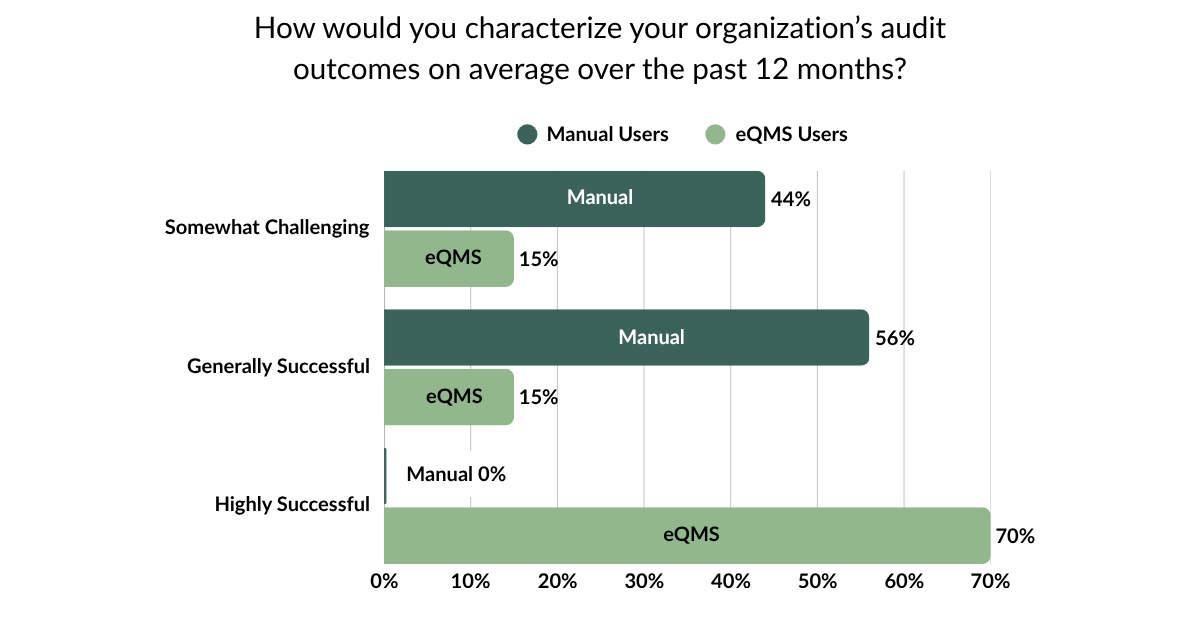
Among eQMS users, 70% describe audits as highly successful, while 0% of manual QMS teams categorized their audits as such.
-
Manual QMS teams are 8x more likely to see document version control as a 'severe challenge' than teams using eQMS.
-
Quality teams using an eQMS resolve quality issues 2.7 weeks faster that manual teams, and periodic reviews are completed on time more often.
- eQMS users are nearly twice as likely to rate both training and document management as “highly effective.”
Seeing the pattern?
Together, these benchmarks suggest that digital systems are about efficiency and effectiveness. They help teams maintain consistency, control, and confidence under pressure.
Beyond Compliance: The ROI of an eQMS
The compliance gap between manual and digital quality management is clear, but that’s not the only factor. The difference also shows up in dollars and cents.
Using our ROI Calculator, we estimated that organizations managing quality manually spend approximately 3,200 hours per year on quality-related administrative activities. With an average quality professional salary of $80,000, that equates to roughly $127,604 in annual labor cost dedicated to manual quality management tasks.
Based on the efficiency benchmarks in the report, an eQMS cuts time spent by roughly half.
That’s a potential gain of ~$64,000 per year in reclaimed time. Time that can be redirected toward proactive quality improvements, more thorough audit preparation, risk mitigation, and strategic initiatives that strengthen compliance rather than simply maintain it.
Download the Full Industry Report
Want more insights like this on the quality management industry?
In our latest report, Quality Management in Life Sciences: Benchmarks, Burdens, and Breakthroughs, we break down:
-
The average size and resource allocation of Quality teams
-
Typical workload volumes across documents, training, audits, and CAPAs
-
Quantifiable efficiency and compliance differences between manual and digital QMS environments
-
Sector-by-sector quality benchmark data
-
Insights on AI readiness and use in Quality Management
And if you're evaluating how to build a strong digital foundation, our team at ZenQMS is always here to help you think through what that evolution should look like for your organization.