
.png?width=300&name=MRR%20AI%20blog%20image%20(1).png)
You’d be hard pressed to find an industry webinar or conference agenda recently that doesn’t mention AI. In fact, with the extent that AI is dominating life sciences discussions, you might assume the majority of quality teams are already actively using AI in their day-to-day work.
The reality, however, is much more nuanced.
In our newest quality industry research report, we surveyed 100 quality management teams across a variety of life sciences sectors to find out more about the current state of AI in quality management.
In short, quality teams are receptive, but not reckless.
Today, only 10% of respondents reported currently using AI in quality operations. Most organizations are still observing rather than experimenting, understandable in environments where compliance risk is high and regulatory expectations are rigid.
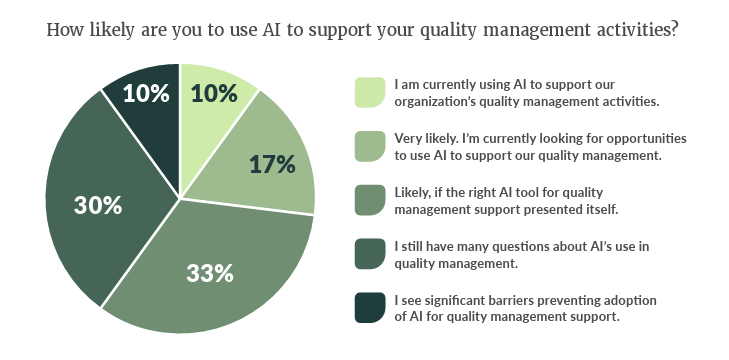
When we asked how likely organizations are to use AI in quality:
-
17% are very likely and actively exploring opportunities
-
33% aren’t actively looking, but would consider it if the right solution presented itself
-
30% are hesitant because of many unanswered questions
-
10% clearly see significant barriers preventing adoption
-
10% are currently using AI to support quality management
That means roughly half of the industry is open to AI in the near future, even though they aren’t implementing it today.
AI Appetite vs Apprehension in Quality Management
Though 60% of respondents were either using or open to using AI to support quality management activities, 80% reported at least one major concern about incorporating AI.
This is where curiosity meets caution. As one survey respondent puts it, “AI is impressive for rapid document creation and analytics, but risk-based adoption is essential. It isn’t a replacement for human oversight.”
The most common barriers to AI adoption in quality management include:
-
Data security and privacy
-
Unclear return on investment
-
Regulatory constraints, limiting experimentation
-
Organizational resistance to change, particularly in more traditional environments
A closer look at responses broken down by sector show heavy interest from contract research organizations (CROs), and the highest current AI use from Packaging/Logistics.
| Sector | Currently Using AI | Strong Interest |
| Manufacturing | 7% | 41% |
| Biopharma | 9% | 49% |
| Packaging | 12% | 57% |
| Labs | 10% | 44% |
| CDMO/CMO | 9% | 33% |
| CRO | 10% | 75% |
The Surprising Link Between Quality Maturity and AI Openness
You might assume quality teams struggling to maintain compliance would be the most willing to adopt AI for support.
Surprisingly, that doesn't seem to be the case.
Respondents who describe their current QMS as “highly effective” are 30 - 40% more likely to consider adopting AI, while those with minimally effective systems show much lower openness (10 - 20%).
Instead of being driven by a desperate need to improve their quality systems, it seems Quality teams first want a solid, low-risk foundation of quality before adding a layer of innovation. It makes sense.
When asked how they would use (or are using) AI for quality management support, the responses point to the same desire to introduce as little risk as possible. The focus is on reducing admin lift rather than regulatory decision-making.
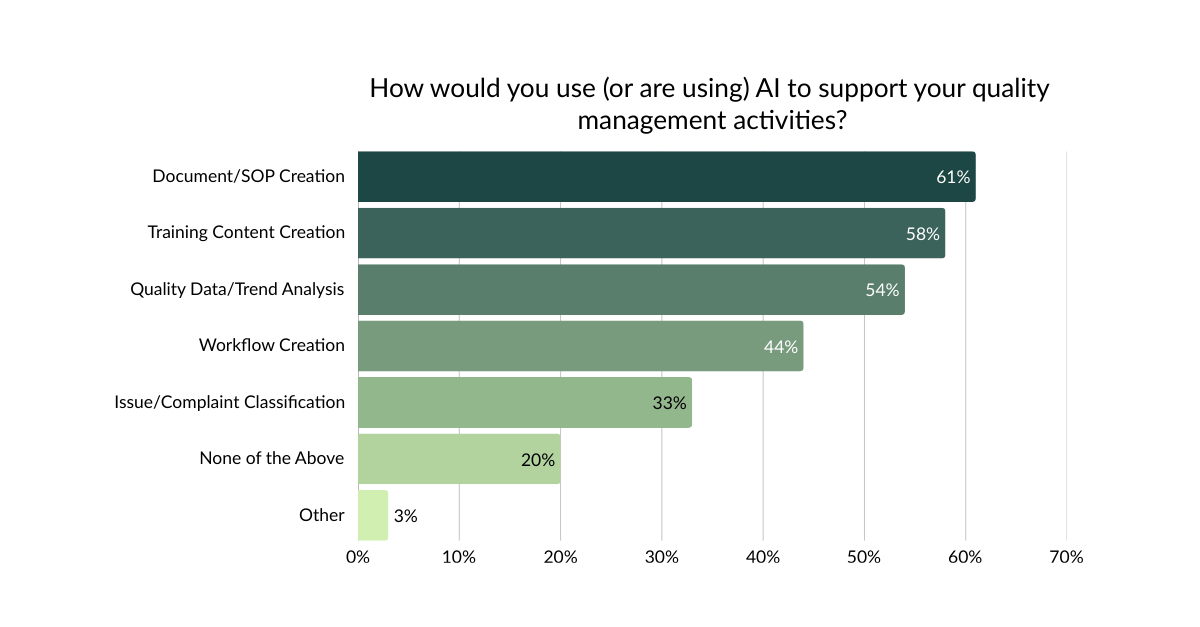
For quality teams, the data suggests a few key takeaways:
-
AI won’t replace Quality professionals. Human oversight remains non-negotiable.
-
Your quality foundation matters more than ever. If your QMS is fragmented, manual, or spreadsheet-based, AI may add risk.
-
The biggest opportunity is in operations, not regulatory expertise. AI can cut down on tedious admin time so quality teams can focus efforts on strategic quality initiatives that strengthen compliance rather than simply maintain it.
Download the Full Industry Report
Want more insights like this on the quality management industry?
In our latest report, Quality Management in Life Sciences: Benchmarks, Burdens, and Breakthroughs, we break down:
-
The average size and resource allocation of Quality teams
-
Typical workload volumes across documents, training, audits, and CAPAs
-
Quantifiable efficiency and compliance differences between manual and digital QMS environments
-
Sector-by-sector quality benchmark data
-
And more insights on AI readiness in Quality
And if you're evaluating how to build a strong digital foundation before exploring AI, our team at ZenQMS is always here to help you think through what that evolution should look like for your organization.