

No two Quality teams operate under the same conditions. Different compliance needs, company sizes, and (maybe most notably) available resources shape how teams prioritize their work and what tools they have to support it.
In the 2026 Quality Management in Life Sciences Report: Benchmarks, Burdens, and Breakthroughs, we surveyed 100 quality professionals to get a better look at the real quality management resource landscape, i.e. the team sizes, tools, budgets, and operational demands shaping modern Quality teams.
The results paint a pretty clear picture: Quality teams are doing essential, high-stakes work under increasingly demanding conditions.
We go into the details below, but let’s start with a sneak peek:
- Quality management teams spend between 340 and 442 hours a year on new document creation.
- The average quality team spends 20.5 hrs preparing for each audit.
- More than half of respondents operate with only 2–5 people on the quality team.
- 35% of respondents had no current budget for quality management tools.

The Quality Resource Landscape: Average Quality Management tools, budgets, and team sizes
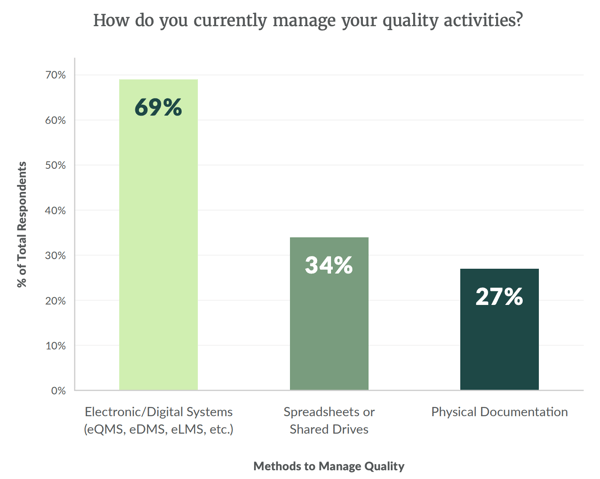
Physical paper is a thing of the past in many industries, but not in Quality Management. Most report respondents said their organizations use a mix of digital and manual systems to manage quality operations.
Nearly 70% leverage electronic systems such as eQMS (electronic quality management system), DMS (document management system), or LMS (learning management system) platforms to manage core processes.
That said, even with seemingly broad digital adoption, 34% continue to rely heavily on spreadsheets or shared drives, and 27% maintain some level of physical documentation.
The staying power of paper is surprising.
After all, this is an industry where any mistake, any lost document, any preventable slow down can have a huge impact. How is this possible?
Take a look at the typical Quality team budget and you’ll start to see the full picture…
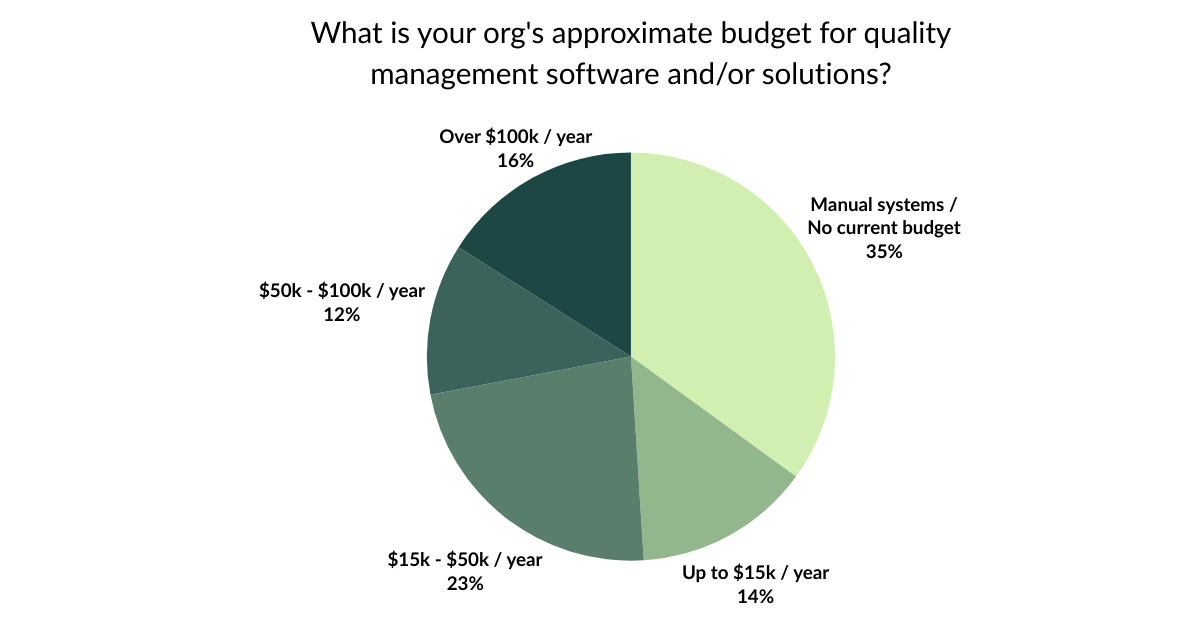
“Do more with less” might be the universal mantra of quality teams based on the typical team size and budget allocation.
Only 7% of respondents report a single-person quality team, but more than half (53%) operate with only 2–5 dedicated staff. Plus, nearly half of all organizations operate with less than a budget of less than $15k.
If you take a look at the full report, you’ll see demands across document control, training oversight, audit preparation, and issue management are growing without similar increases in staffing or dollars. And, of course, operational bottlenecks run rampant.
Quantifying the Quality Workload
Quality teams know "success" looks like the protection of patients, reputation, and revenue, avoided delays, and safe products.
But there’s a catch: these things are hard to measure. Unfortunately, that means the critical impact of quality teams often goes unnoticed. And so do their needs.
In the full report, we attempt to quantify that quality workload, covering the volume, complexity, and time investment required.
Operational Complexity
The sheer amount of quality activities – and their complexity – vary widely across organizations. Below, we share the averages across all industries, but check out the full report to see specifics across life sciences sectors including Biopharma, Manufacturing, CROs, CMOs, Laboratories, and Logistics/Packaging.
-
Average Total Documents Managed: 611.75
-
Average number of new documents created every year: 34.1
-
Average percentage of documents actively trained on per year: 40%
-
Average number of documents each role must train on in a life sciences organization: 24
-
Average number of quality events per month: 23.25
- Average number of audits handled per month: 4.1 external audits, 8.3 internal
Operational Complexity
Now that we have a better idea of how much work the average quality professional has to juggle, it’s time to look at… time.
Time is one of the most limited resources Quality teams have. Drafting documents, managing training, preparing for or responding to audits, and resolving issues all compete for attention within already full workweeks. (And remember, the majority of Quality teams consist of only 2 - 5 people.)
Notably:
-
On average, quality teams spend nearly 4 hours a week compiling, tracking, and reporting on training each week
-
The average quality team spends 20.5 hrs preparing for each audit. Looking at the extremes, 6% spend over 72 hours on prep, while 7% spend only 1 hour.
-
The majority of quality issues take 3 - 4 weeks to resolve from identification to closure.
-
It typically takes between 10 to 13 hours of work per document from draft to approval.
Let’s look closer at that last stat.
If you consider an average of 34 new documents created per year, Quality professionals are spending between 340 and 442 hours a year on new document creation. That’s upwards of 11 straight workweeks spent solely on documents.
Keep in mind, that doesn’t even include:
-
Upversioning
-
Retiring
-
Periodic reviews
-
Chasing approval signatures
-
Or any other critical document management activities
It’s easy to see why Quality teams feel stretched – and why making sure they have the tools and resources they need is critical.
Download the Full Industry Report
Want more insights like this on the quality management industry?
In our latest report, Quality Management in Life Sciences: Benchmarks, Burdens, and Breakthroughs, we break down:
-
The average size and resource allocation of Quality teams
-
Typical workload volumes across documents, training, audits, and CAPAs
-
Quantifiable efficiency and compliance differences between manual and digital QMS environments
-
Sector-by-sector quality benchmark data
-
Insights on AI readiness and use in Quality Management
And if you're evaluating how to build a strong digital foundation, our team at ZenQMS is always here to help you think through what that evolution should look like for your organization.